Connect 12
Connect is the field hub that turns ordinary cue outputs into intelligent, routed, monitored firing paths. Keep your existing controller — Connect makes everything downstream smarter, safer, and easier to verify.
Why it matters
Crews can keep their existing controller while gaining cleaner wiring, smarter routing, per-igniter continuity visibility, and better pre-show field status.
The hardwired firing backbone that makes your existing system smarter, safer, and dramatically more capable.
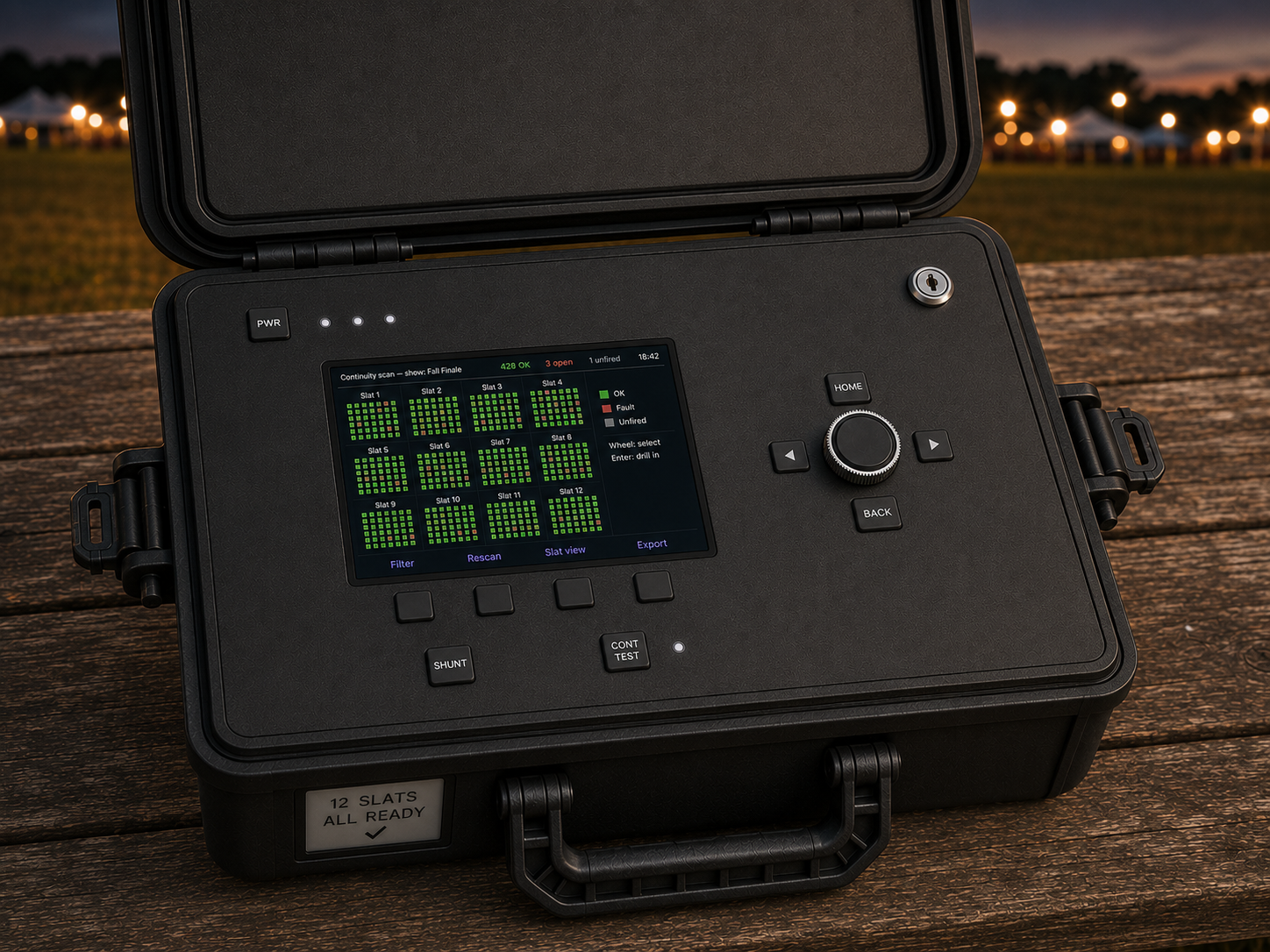
Open the lid and a single 7" display shows live output status for every port — adapting to whatever mix of IQ Slat variants you have connected.
Connect sits between your existing firing controller and your product. It takes trigger inputs from whatever system you already own, generates 24V firing voltage, routes cues across up to 12 IQ Slats (9, 18, or 36-bank variants), and manages continuity, safety interlocks, and real-time field monitoring — all in a sealed, IP65-rated field enclosure built for the firing line.
Capacity
12 slat ports. Every configuration. Up to 1,296 igniters.
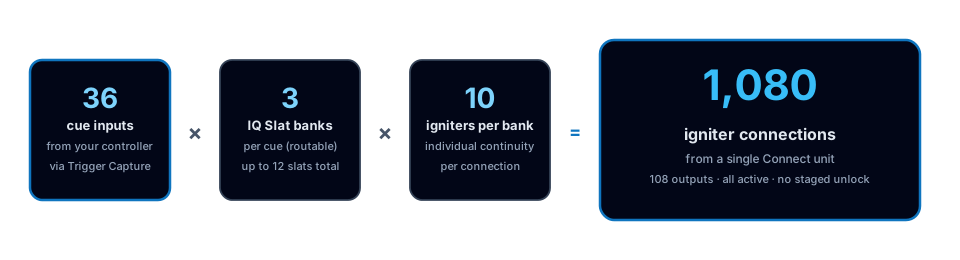
Connect 12 has 12 IQ Slat ports. Every slat variant — 9, 18, or 36 banks — delivers 108 outputs per slat, for a consistent 1,296-output ceiling across the full system. Choose the variant that matches how you fire; the total capacity stays the same.
12 IQ Slat ports
Each maps to your existing controller's trigger signal via EM2 Bridge — your existing firing system.
108 outputs per slat
Every IQ Slat variant — 9, 18, or 36 banks — delivers 108 outputs. Route any bank to any position, or fan across multiple banks for synchronized effects.
Up to 1,296 igniter connections
Every individual connection is continuity-tracked. Not just per cue — per igniter.
One-to-many routing
Configure any cue to fire across multiple output blocks simultaneously — mirrored positions, redundant product, or synchronized multi-rack effects. Set up in software, no rewiring.
What this means in practice
Connect's arming sequence, continuity isolation, and power architecture were designed against NFPA 1123 and 1126 firing safety requirements. See the full compliance mapping →
Safety architecture
Hardware safety that doesn't depend on software working correctly.
Every safety layer in Connect is designed so that a software fault, a firmware bug, or a lost signal cannot cause an unsafe firing event. The most critical protections are hardwired — not code.
Hardware shunt relays — fail-safe at power-off
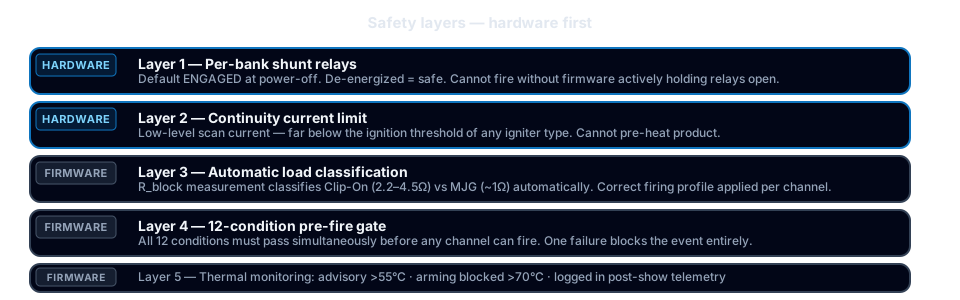
If something goes wrong — a dead battery, a tripped cable, anything — the system doesn't have to notice and react. It's already safe by default. There's no window where things are unprotected. Per-bank relays physically short the firing voltage rails to ground when de-energized. The default state — at power-off, on reset, or on any power interruption — is ENGAGED (safe). Firing voltage cannot reach the IQ Slats unless firmware actively holds the relays open. Cut the power and the system is safe, instantly.
Wet-chain detection — hardware firing block
Every connector is sealed to IP65 — so once a connection clears the wet-chain check, it's confirmed dry for the show. If something wasn't seated properly, Connect catches it during setup, at that specific connection, before you ever arm — not as a surprise mid-show. A dedicated sensor monitors the trigger harness for wet or fault conditions. If a wet harness or wiring fault is detected, firing is blocked at the hardware pre-fire gate — independently of firmware state. Connect cannot fire when a wet-chain condition is present.
Continuity current orders of magnitude below ignition threshold
Continuity checks can never accidentally fire an igniter — no matter how many times you run them or how long everything stays connected. Check continuity as often as you need, worry-free. Connect's continuity scanning uses a low-level current pulse — far below the threshold required to pre-heat or ignite any igniter type. Continuity checks are a passive measurement, not a firing event. Safe with all igniter families.
Automatic load classification
You don't have to tell Connect what kind of igniters you're running or manually configure firing settings. It checks continuity and classifies load at the individual pin — not just the bank — so you can mix igniter types even within the same bank. Connect measures the resistance of every connected igniter block and classifies it automatically. MJG pyrogen bridge igniters and Clip-On nichrome igniters have different resistance profiles and require different firing profiles — voltage, dwell time, and energy delivery. Connect identifies the type and applies the correct profile automatically. Connect is also designed to work with other igniter families — MJG and Clip-On are the most common types in the field and are fully supported from day one.
12-condition pre-fire gate
Before anything fires, Connect checks a dozen conditions at once — every single cue, every single time. That's a level of consistency no crew can match by hand. If even one thing is off, it stops and tells you exactly why, instead of leaving you guessing. Before any channel can fire, the Safety Engine verifies all pre-fire conditions simultaneously — trigger path integrity, wet-chain clear, shunts released, PSU above minimum threshold, slat presence and addressing valid, telemetry fresh for all target slats, no driver faults latched, cooldown satisfied, routing constraints met, and load classification valid. Every condition must pass. One failure blocks the entire firing event with a logged reason code.
Thermal monitoring with arming block
Connect's components are rated for extreme conditions — from -20°C to +60°C — built to handle a hot truck bed on show day or a cold outdoor winter show without failure. As an added backstop, Connect also monitors internal temperature continuously and will block arming if conditions ever exceed safe limits — a safeguard you're unlikely to ever need, but it's there. An NTC thermistor monitors enclosure ambient temperature. Advisory warning above 55°C; arming is blocked above 70°C. Prevents operation in conditions that could compromise component reliability.
Per-channel output fault protection
If one wire is shorted or damaged, only that connection gets flagged and blocked — not your whole show. You'll know exactly which connection had a problem and when, instead of discovering a mystery failure mid-performance. Every output channel has built-in overcurrent, thermal shutdown, short-to-ground, and open-load detection. If any channel in a firing path has a latched fault — before or during a firing event — Connect blocks the route entirely. Faults are logged with timestamp and channel address for post-show review.
PSU collapse detection — mid-fire abort
A partial ignition — where an igniter gets some but not all the energy it needs — can be unpredictable and dangerous. If power dips mid-fire from a long cable run or an aging battery, Connect aborts immediately rather than risk it. Connect monitors firing voltage continuously. If a voltage sag or PSU collapse is detected during a firing event — from an overloaded cable run, a wiring fault, or a dead battery — the firing event is immediately aborted, a fault is latched, and cooldown is enforced before the system can fire again. Prevents partial ignition from undervoltage conditions.
Per-block cooldown enforcement
Connect is built to handle fast, rapid-fire sequences — fans, chases, and chase effects — at the speed your show demands. An intelligent per-block cooldown system tracks thermal load in real time, giving you maximum firing speed while automatically protecting your hardware and igniters in the rare case a sequence pushes beyond safe limits. Every output block has an independent cooldown state machine based on the thermal load from the most recent firing event — current drawn, dwell time, and load type. Connect will not re-fire a block until cooldown is satisfied. Prevents thermal damage from rapid re-fire sequences and protects both the switching hardware and the igniters.
Boot-safe hardware state
Powering on or rebooting in the field never risks an accidental output — even in the split second before the software has even started running, the hardware itself is already safe. On every power-on or reset, all output shunts are engaged and all switching outputs are disabled at the hardware level — before firmware runs a single instruction. There is no window during boot where the system could produce an unintended output. The system only exits this state after the full safety initialization sequence completes and all pre-fire conditions are verified.
Displays and indicators
Full visibility into every channel, always.
7" color display
Live continuity status for every cue and every connected slat. Per-slat IMU angle data during setup. System state, fault logs, and firing history. On the top face — operator looks down during setup and pre-show checks.
Dedicated status indicators
One LED per output channel, visible through a frosted polycarbonate insert on the top lid. Green/red per channel, updated in real time as continuity scans run. At a glance you see which of 108 channels is good and which needs attention — before you ever arm.
E-Ink display — always on
The E-Ink panel is on the front face of the base enclosure — not on the lid. It's visible whether the lid is open or closed, and remains active while the unit is off and charging. Shows system state, slat count, battery level, and charge status. No power required to hold the image.
Status LED array
Per-slat connection status (12 indicators), system status, power, battery, and continuity/shunt state — all on dedicated bi-color LEDs independent of the main display. Always readable even during early boot or fault conditions.
Continuity emulation for legacy controllers
Your controller's continuity display works exactly like it always has — no retraining your crew, no new screens to learn. From the operator's seat, nothing about your existing workflow changes. When Connect sits between your existing firing controller and the igniters, the host controller's continuity probe would normally see an open circuit. Connect emulates a valid load back to the host — so your legacy controller shows normal continuity feedback exactly as it did before PyroNext was installed.
Ignition confirmation — not just fire confirmation
Most systems can only tell you a cue fired — not whether anything actually lit. Connect reads the current signature after every shot and can tell the difference between a successful ignition, a misfire, and a broken wire. If something didn't go off as expected, you'll know exactly which one and why — instead of wondering. A successful ignition produces a characteristic current profile — spike then decay — that is distinct from a misfire or wire break.
Post-show telemetry record
Every show generates a complete telemetry record: firing confirmations per channel, fault events with timestamps, peak enclosure temperature, PSU voltage readings throughout the show, and continuity state before and after each firing sequence. Exportable for compliance documentation, insurance records, or reliability review.
Real-time slat health monitoring
If a slat loses connection, drops a signal, or starts behaving unusually, Connect notices immediately — and blocks firing for that position automatically. You find out about a problem during setup, not when a cue doesn't fire. Connect continuously polls every connected IQ Slat for voltage, current, temperature flags, and sequence counters.
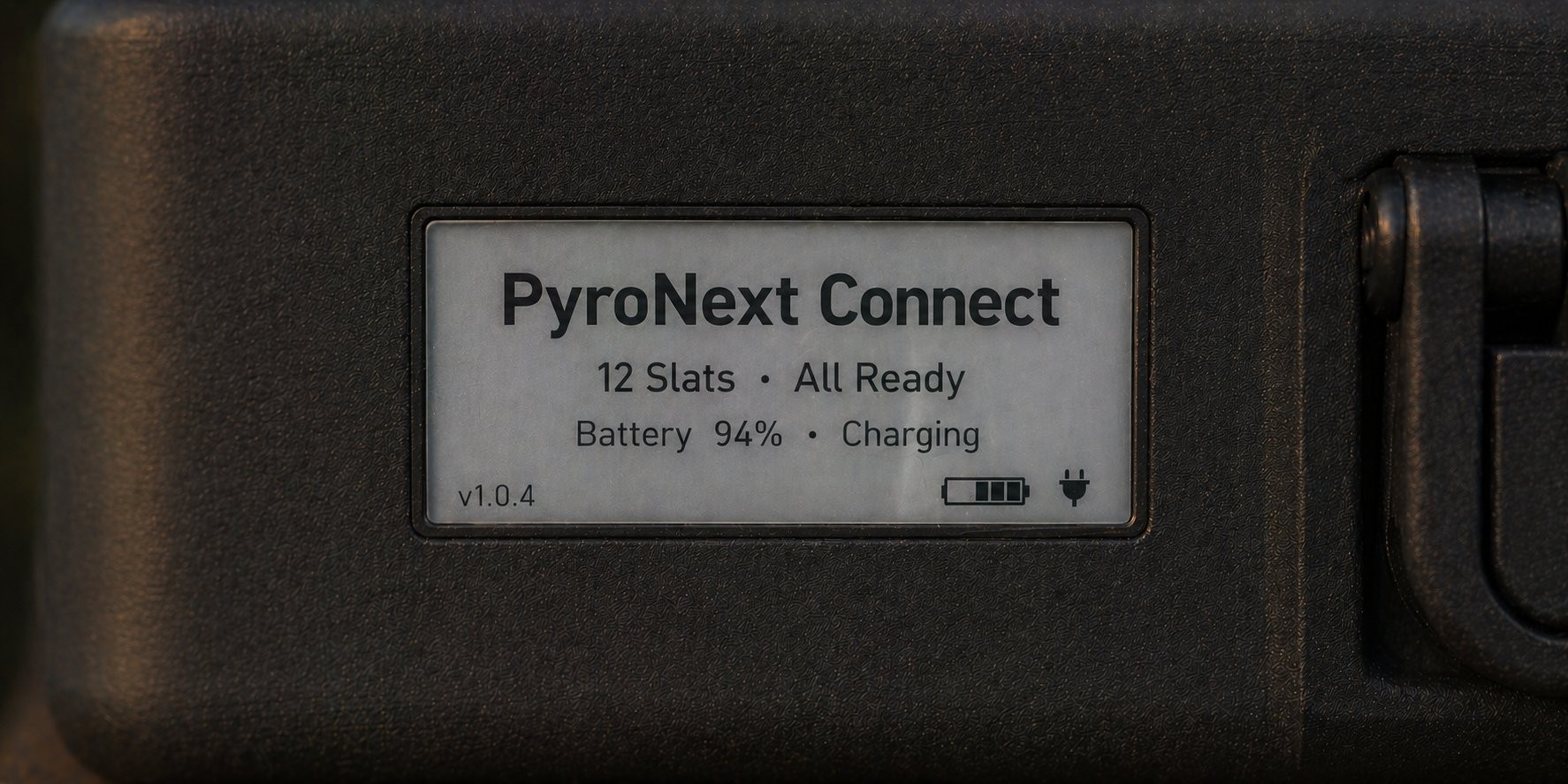
E-Ink display on the front face — always visible, no backlight, readable in direct sunlight. Active even while charging with the unit off.
Enclosure
IP65. Sealed. Built for outdoor shows.
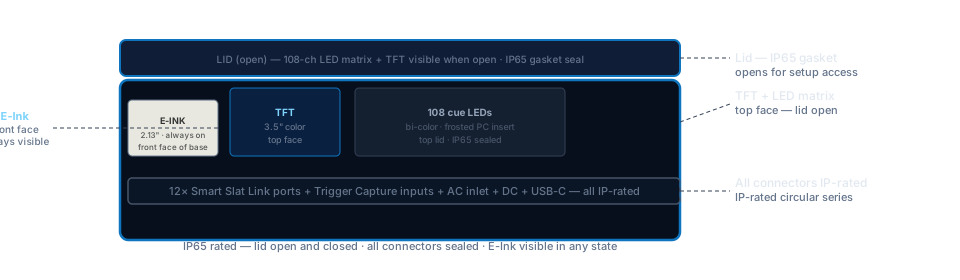
IP65 rated
Dust-tight and protected against water jets — with the lid open or closed. Gasket seals on the lid perimeter, display window, and every panel connector ensure the rating holds in real field conditions.
Pelican-style latched lid
Over-center compression latches maintain gasket preload. Operable with gloves. The lid opens to expose the 7" display for setup; closes to seal everything for transport and during the show.
E-Ink always visible
Because the E-Ink is on the front face of the base — not the lid — system status is readable in any configuration: lid open during setup, lid closed during the show, or charging overnight in a case.
All connectors IP-rated
Every external connector on the enclosure is IP-rated and circular — 12 Smart Slat Link ports, trigger input ports, AC mains inlet, DC input, and USB-C. No exposed bare connectors anywhere.
Power
All-day battery. AC mains. Both IP-rated. Both field-serviceable.
| Battery chemistry | Lithium-ion, 4S1P — LG M50Lt cells |
| Nominal voltage | 14.76V |
| Capacity | All-day field capacity — field-replaceable pack |
| Continuous draw | 5A |
| Peak draw | 15A |
| Main connector | High-current field connector |
| BMS location | On-board — integrated cell monitoring with NTC thermal protection |
| AC mains input | 120Vac via IP-rated panel inlet — full system operation on AC mains, independent of battery |
| Charging | Via AC inlet; E-Ink and battery monitoring active while unit is OFF |
| Battery replacement | Field-replaceable — bottom hatch with captive M3 screws, no tools required |
| Fuse access | Field-accessible — dedicated bottom hatch with captive M3 screws for fault recovery |
Legacy compatibility
Works with the controller you already own.
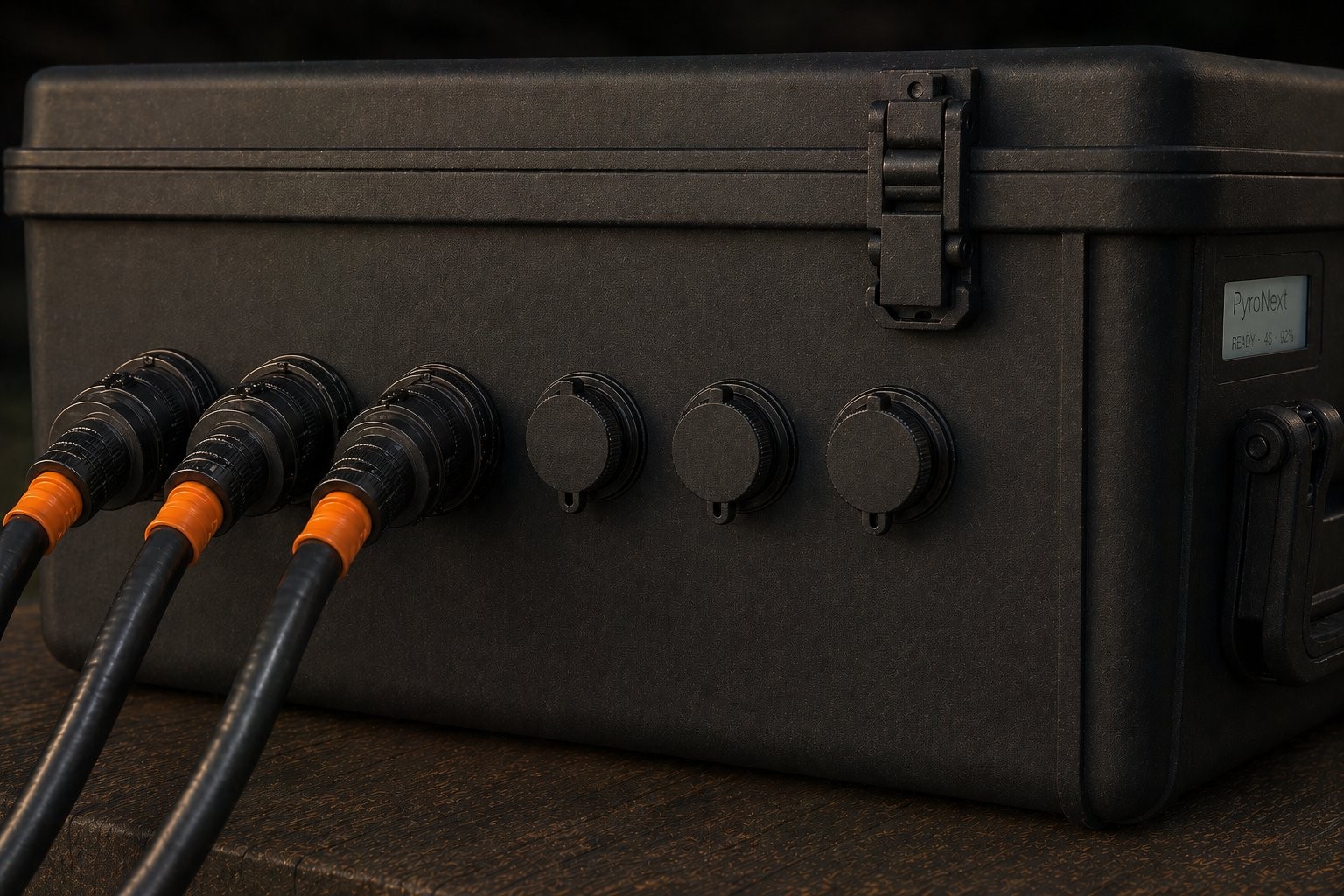
Smart Slat Link ports — 10mm industrial field cables, IP-rated circular connectors, orange strain reliefs. Built for real field conditions.
EM2 Bridge accepts cue outputs from compatible existing firing systems through controller-specific field harnesses, classifies the incoming signals, and passes them to Connect 12 through the isolated Bridge interface. The host controller's firing domain is galvanically isolated from Connect 12's internal logic — clean grounding, straightforward safety analysis.
See cable adapter and harness options →
Full specifications
| Controller inputs | 36–144, via one to four EM2 Bridge units |
| IQ Slat ports | 12 |
| Monitored output connections | 108 per slat — up to 1,296 per Connect 12 |
| Supported slats | IQ Slat 9, IQ Slat 18, IQ Slat 36 — freely mixed |
| Max igniters | 1,296 (108 per slat × 12 slats, every variant) |
| Firing voltage | 24V DC (generated internally via boost converter) |
| Igniter types | MJG pyrogen bridge and Clip-On nichrome — auto-classified. Compatible with other igniter families. |
| Slat connection | 12× Smart Slat Link ports — IP-rated circular connectors |
| Slat cable lengths | 5m, 10m, 15m, 20m field cables available |
| Legacy trigger input | Via EM2 Bridge (external module), galvanically isolated |
| Continuity current | Well below ignition threshold — safe with all igniter types |
| Displays | 7" color display (top face, live output status) + 2.13" E-Ink (front face, always on) |
| Status indicators | System, power, battery, continuity, shunt, and 12-port slat connection state |
| IP rating | IP65 (lid open and closed) |
| USB | USB-C host — file exchange and firmware updates |
| Operating temperature | −20°C to +60°C |
Show design, routing configuration, and pre-show checks are handled in the Studio App →
Development status
Connect 12 V1 is in testing. V1.2 is in design, incorporating results from V1 validation. Contact us to discuss early access and pilot testing.